
UNITED KINGDOM · FOUNDATION LEADER
When Competitors Sit at the Same Table
“People rarely collaborate because they've been convinced. They collaborate because they've begun to trust the space they're in.”
3 August 2026·7 min read
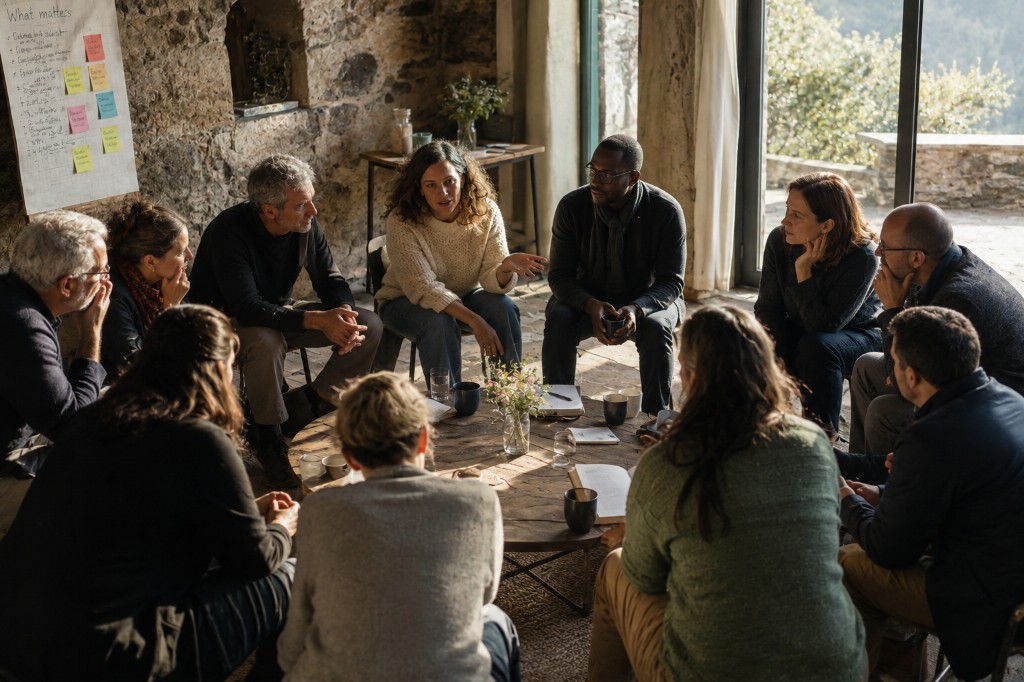
What does it take to bring together people who normally compete—and help them work towards something they cannot achieve alone?
Listening across many tables
This isn’t a conversation with one particular foundation leader.
It’s an editorial reflection, shaped by experiences shared by people who convene organisations, industries and communities around a shared purpose.
We imagined what we might hear if we brought those experiences into one conversation—and truly listened.
VOICES: You spend your time bringing together organisations that don’t normally work together. What have you learned?
THE CONVENER: That most people don’t arrive as people.
They arrive carrying an organisation. A title. A responsibility. They’re thinking about the meeting ahead, the expectations of those they represent, and what they can or can’t say.
Before anything meaningful can happen, those things need somewhere to rest.
VOICES: How do you make that happen?
THE CONVENER: Not by asking people to leave their roles behind. Those roles matter.
But I try to create moments where they’re allowed to arrive as humans first. That might happen over coffee, on a walk, around a dinner table, or simply through a question nobody expected.
I’ve learned that the meeting often begins long before the agenda.
VOICES: Many of the people in the room are competitors. Doesn’t that create tension?
THE CONVENER: Of course. And that’s not a problem.
The problem is pretending it isn’t there.
Competition often protects something valuable. People care deeply about their organisations, their teams and the work they’re responsible for. You don’t build trust by asking people to ignore those realities. You build trust by creating a space where they can speak about them honestly.
People rarely collaborate because they’ve been convinced. They collaborate because they’ve begun to trust the space they’re in.
VOICES: What makes a good space?
THE CONVENER: Curiosity.
Enough safety that people can admit uncertainty. Enough structure that nobody dominates. Enough openness that something unexpected can emerge. And enough patience not to rush towards agreement.
Sometimes disagreement is exactly what the room needs.
VOICES: Have you ever seen a room change?
THE CONVENER: Many times.
It usually happens quietly. Someone stops speaking on behalf of their organisation and starts speaking from experience. Someone admits they don’t know. Someone asks for help.
The atmosphere shifts. People stop negotiating positions and begin exploring possibilities together.
VOICES: What is your role in those moments?
THE CONVENER: Less than people imagine.
I’m not there to be the smartest person in the room or to have the answers. I’m paying attention to the conditions: who’s speaking, who hasn’t spoken, where the energy is, and what’s happening beneath the words.
If the space is healthy, the conversation gradually begins to lead itself.
VOICES: What’s the hardest part of this work?
THE CONVENER: Accepting that you can’t own the outcome.
You can prepare. Invite. Hold the space. Notice what’s happening. Encourage people to stay curious.
But the conversation belongs to everyone. The best meetings often end with ideas that belonged to nobody when the day began.
VOICES: After all these years, what still surprises you?
THE CONVENER: How much people have in common once the conversation becomes real.
At the beginning, everyone arrives representing an organisation. A few hours later, they’re talking about challenges they’ve all experienced.
Different sectors. Different responsibilities. Often, very similar questions.
That still surprises me.
Our reflection
We often think collaboration begins with shared goals.
Perhaps it begins somewhere quieter.
It begins with creating the conditions in which people feel able to bring more than their position. Where they can speak honestly, remain curious, and disagree without becoming enemies.
Maybe that’s the invisible work behind many of the breakthroughs we admire.
Not finding better answers, but creating better spaces in which answers can emerge.